

Railway Engineering and Nepal
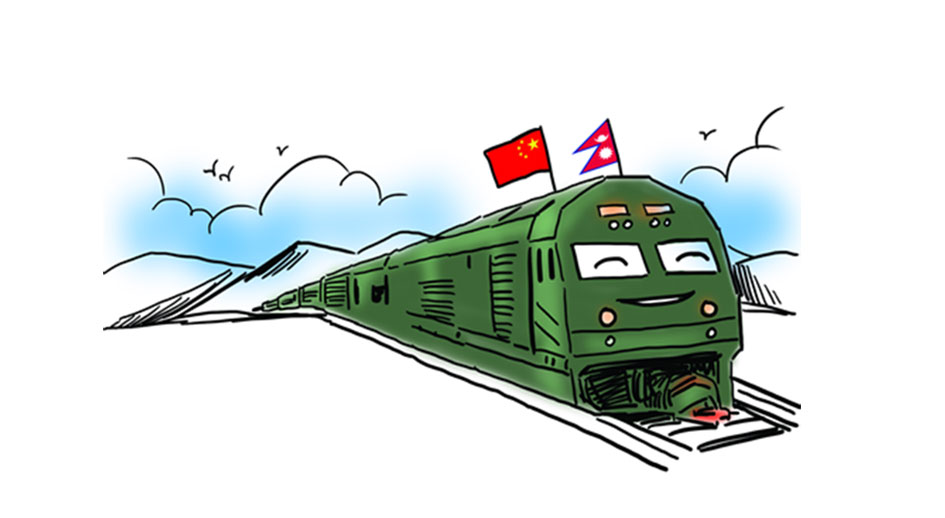
Railway transportation is a means of transferring of passengers and goods on wheeled vehicles running on rails, also known as tracks. It is also commonly referred to as train transport.

Railway Engineering
Railway engineering is a multi-faced engineering discipline.It deals with the design, construction and operation of all types of rail transport systems. It encompasses a wide range of engineering disciplines, including civil engineering, computer engineering, electrical engineering, mechanical engineering, industrial engineering and production engineering. A great many other engineering sub-disciplines are also called upon.
Railway systems entail much more than a train and a track. They are based on advanced technical and operational solutions, dealing with continuously changing demands for more efficient transport for both passengers and freight every day. Each system consists of many components that must be properly integrated: from trains, tracks, stations, signaling and control systems, through monitoring, maintenance and the impact on cities, landscape and people. This integration is the big challenge and the source of many train delays, inconvenient connections and other issues that impact our society.
Railway engineering offers substantial economic benefits, energy efficiency, and environmental and safety benefits to nations all over the world, and rail is widely viewed as a vital component of the integrated transportation system for sustainable and resource efficient societies of the future. There is substantial demand for engineers with integrated knowledge of railway subsystems (infrastructure, vehicles and traffic control) who understand how to maximise performance of the whole system.
Railways in context of Nepal
Nepal is a country with diversity in every aspects.Geographical diversity,topographical diversity and climatic diversity are the main problems faced by the development projects.It’s more economic,effective and easy to make railways in Terai region.Since we dont have any hills where the way needs tunnel .Absence of rocks and the land of same level makes terai region suitable for railways .In the context of Hilly and Mountain region it’s too much costy,hard to do enginnering,Requires more manpower and time consuming.As Nepal is developing country it may be hard to make railways in these regions but Nepal with collaboration with China and india can easily do this

janakpur-jaynagar railway
Impacts of Railways in Nepal and its citizens
1.Urbanizatiion for capital will be less since people can travel from one cities to another at a short time with less money (For eg-students from chitwan can take a train to go to kathmandu to take college)
2.Import and export will be easy and goods will be cheaper as railways are far cheaper than roadways
3.Maintainance cost will be low once it is completed.
4.Absence of traffic will be really worthy
5.Train is much safer than vehicles since railways accident are very rare.
Railways engineering in Nepali universities
As there is no railway engineering in Nepal.By the China-Nepal colaboration ,chinais planning to to train nepali engineers for railway engineering.IOE(Institute Of Engineering) is also trying to bring new course as railway engineering by 2020AD.As Nepal is showing much intrest in railways.It’s certain that we will be able to get railway engineering in one of five colleges by IOE.
Nepal China Railway Relation
The ambitious Nepal-China rail link, which is expected to break the tiny Himalayan nation’s sole dependence on India for trade and transit, is looking financially unfeasible as disagreements crop up between principal stakeholders.
There is no consensus among political actors about how this project, which is part of the Chinese Belt and Road Initiative, should be funded.
Moreover, the railway would be challenging to build. The mountainous terrain poses a major challenge. The Chinese side has been saying that the project needs further study and depends on new technological advances, as the proposed route runs through the earthquake-prone Himalayan range.All in all, there has been more “diplomatic propaganda” than actual progress on the ground, in terms of expediting work for the railway, said foreign affairs and geopolitical expert Geja Sharma Wagle. “There is high symbolism, but less substance.”
A difficult project
During the fourth Nepal-China
Railway Cooperation Committee meeting held in Beijing in the third week of June, Chinese officials had conveyed to the Nepali side that they would have to work out a few things before they start to prepare a detailed project report.
The Chinese Railway Administration had conducted a pre-feasibility study of the project last year. That report submitted to the Ministry of Physical Infrastructures and Transport Management indicated it would be a challenging engineering undertaking owing to various concerns – seismic activity, topography, altitude, geology and engineering.
In a press conference held in May this year, the Chinese Ambassador to Nepal, Hou Yanqi, said the construction of a railway through the most inhospitable terrain at the highest altitude requires further scientific and feasibility studies and innovation.
Hou issued a statement in which he said that although the construction of a Nepal-China cross-country railway was a long-term project, the participants had the determination to continue the work. He also emphasized the need to display a scientific attitude and patience.
Amid these uncertainties, as the fourth Nepal-China Railway Cooperation Committee meeting held in Beijing could not decide on expediting the detailed project report, it will be discussed in the fifth meeting, scheduled for December in Kathmandu.By itself, a proper feasibility study of the 72-kilometer railway line from the Chinese border is estimated to cost around 35 billion Nepalese rupees (approximately US$319 million), according to Nepali Railway officials.

You may also like

New Dem File Of Nepal

Applied mechanis And Its Solutions
